Memorial Day Memories, Once Again

Much of today’s piece is from something I wrote last year, but seems appropriate to use it once again. Originally called “Decoration Day”, Memorial Day began in the years following the Civil War to commemorate the vast loss of life, of the soldiers that died on both sides of the conflict. Later, all military that died in battle.  Thus began the tradition of putting flowers and flags on graves in the spring, and it spread from military dead to family members and friends. It was unofficial until 1971, when Memorial Day became officially a national holiday.  

When we were younger, it was a tradition that my father, my brother, and I would travel down to Southeastern Massachusetts, where my great uncles Herbert and Warren lived.  Mother would have packed a picnic lunch, and we’d “make the rounds” of the cemeteries. Uncle Herb would have flats of flowers that he’d grown in his greenhouse ready. None of this Memorial Day for him – he always called it “Decoration Day”. Uncle Warren never came with us, as he never went out of the house.  Except to go to work at the horse farm next door, to which he walked across a large field.  He even shoveled himself a path through the snow in the winter, so he didn’t need to go near the road.  I think he considered cars as “handmaids of the Devil”. He’d worked at the farm for years, and confided one day that he absolutely hated horses!  Anyway, that was our first stop.  Flowers in hand, off we’d go to visit the graves of family.  We’d first stop at the graves of my great grandparents, and Herb would show us his plot and his brother Warren’s, “where they would be”, as he’d tell us proudly.  I always thought it just a bit creepy, but it gave him a sense of pleasure and peace, so that was fine.  We’d nod and make appreciative noises, as only a ten or eleven-year-old can.

Next, we’d proceed to my grandfather’s grave.  His was by itself, in a large cemetery in Jamaica Plain, for whatever reason.  Charles Walters was sort of a mystery to all of us. He arrived from somewhere down south, and married my grandmother, who was quite a bit older than he.  He died, sadly at age 31, when my father was 3.  So, basically a question mark.  The only thing we have from him is his violin, so we know there’s a musical connection there, but otherwise, not much to go on.  The Princess and I did some research on him on Ancestry one year.  We didn’t turn up a lot, so Elizabeth concluded that he was probably a fugitive from something.  Perhaps it’ll be a “true crime” documentary at some point. The final stop was at the grave of my grandmother, who was buried where her third and final husband would later be.  He was still alive when we were young, well into his 90’s.  We’d stop at his house in Canton, Massachusetts, to say hello.  His house was on the street where my father lived growing up, and farther down, we’d stop to visit a lovely lady Uncle Herb’s age, May.  She’d grown up with Herb, and we always suspected that he’d held a candle for her in their youth.  (For you younger readers, that means he liked her.)

In high school, our band would make the rounds for various observances. I went to a regional school in Southwestern New Hampshire, so we had multiple sending towns for whom we participated.  The band would play in the Southern towns first – Fitzwilliam and Troy, and then end up in Swanzey, the largest of the regional system.  The parade in Troy was memorable because the parade would loop through the long town square and meander down to the river that ran below it.  There, we’d have a ceremony where a veteran or a Gold Star Mother would toss an elaborate silver wreath into the water in memory of those lost at sea.  The wreath would float gently past and under the bridge while we played something suitable – probably the Navy Hymn, until it disappeared from view.  It was very moving until one year, as we were returning to the square, we noticed that there was a man on the other side of the bridge in waders, with a fishing pole ready to snatch the wreath out of the water so it could be reused the next year.  Apparently, the wreath was as old as most of the WWII veterans in attendance. A touching combination of ceremony and Yankee frugality.  

In the small village, where I grew up, there was a Civil War memorial.  A period cannon, along with the requisite stack of cannonballs sat on a raised area right next to the triangle in front of the Congregational Church.  To be completely honest, I don’t ever remember anything happening on Memorial Day of any significance.  Later in the summer, Old Home Day was the larger event, with young folks in costumes, bicycles and baby carriages, usually the town’s fire engine and snow plow would make an appearance.  Then a big pot luck supper.  We’d moved there when I was in the fourth grade from a suburb of Boston, and my mother wasn’t altogether trusting of the local cuisine.  But we partook, and all of us lived to talk about it.

The next town over, Nelson, is where my father’s roots ran deeply.  The old family homestead is there, where members of my grandmother’s family, the Hardys, have lived since the late 1700’s, and many branches are buried in the local cemetery.  In fact, my father is buried in this cemetery, so we go over each year and put some flowers there, along with a flag.  Nelson has a bit more happening.  A parade with the town band was lining up to march to the cemetery one year as we were passing through, and we had to take a back road to escape. The town band, quite a festive group for a small town, also plays for July 4th, when they are mounted on a couple of boats tied together and proceed around Granite Lake, finishing up just before the fireworks.  

My wife, Her Ladyship’s family has some protocols for the family graves in the nearby city of Keene.  My late father-in-law was usually in command of the plantings.  His preferences were for red geraniums, with marigolds in front.  In later years, we took over, but maintaining the planting diagrams exactly.  Herself and her father planted the flowers one year in my absence – I had a parade or some such.  My wife is not what you’d call an “outdoorsy” person, and in fairness, she was dressed up in school principal attire.  In laying out the plantings, her father told her she “dug like a dog”.  I don’t think he meant it as a compliment.  A few years back, some friends took it upon themselves to put in a small enclosed garden in front of the gravestone, with some pretty flowering things and a couple of perennials.  Just a year or two after that, the rulers of the cemetery decreed that all of those plantings got in the way of their crew’s mowing. Judging by the number of times they appeared to actually mow, it didn’t seem like a problem to me, particularly as the summer wore on.  A small herd of goats could have done a neater job.   But a rule is a rule, so out went the plants. In recent years, we just put small containers with flags in front of the headstones so the fine team of maintenance people can remove them as needed. This year, I found some nice-looking containers, but they were yellow and purple, a departure from, and probably a violation of my father-in-law’s Code of Color.  I’ll probably be visited by his spirit, asking me what happened to the red geraniums.

One of my favorite Memorial Day stories came from a colleague, who was a band director up in the North Country.  He related to us at dinner one year at a conference, that his high school band was situated at the front of the parade.  They stepped off and marched crisply through town.  As the band came up to the Fire Station, the Fire Department thought it would be a nice touch to blow the whistle alarm in salute.  The director, not knowing that, and assuming the doors would fly open and fire trucks would roll out and crush the band, he directed the drum major down a side street and onto an alternative route, literally into less traveled parts of town.  The rest of the parade followed the band on its detour, which extended the parade route a bit and into areas he confided he’d never seen before. Unfortunately, it also took the parade participants away from the waving crowds and the reviewing stand, which was set up just down the street from the fire station.   A story about which legends are made.

Memorial Day provides us all with an opportunity to honor and reflect on those that died in service to their country.  Their heroism and sacrifice.  Or, as Abraham Lincoln phrased it, their “last full measure of devotion.”  Thank you all.

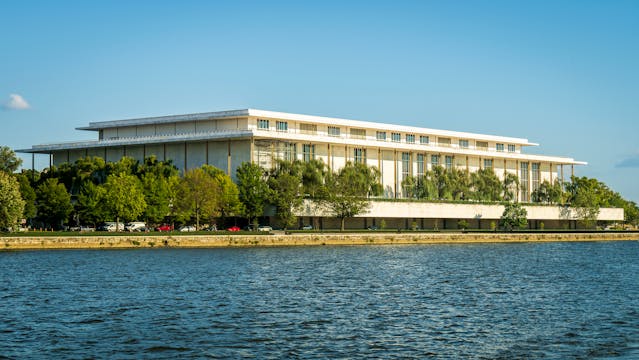
The Kennedy Center: Our Cultural Home No Longer

Shortened to the “Kennedy Center”, it is officially the John F. Kennedy Center for the Performing Arts, sitting majestically on the Potomac. It opened in 1971 to honor the late President for his and Mrs. Kennedy’s great passion for the visual and performing arts.  It contains commissioned works of art, a gallery of flags from around the world, and wonderful performing venues.  It is home to the National Symphony Orchestra and the Washington National Opera. In short, it’s the United States’ cultural home and showplace. 

Continue reading “The Kennedy Center: Our Cultural Home No Longer”

Renewing my Canadian Roots

This week’s piece is a mixture of serious and not-so-much. I was working on something for the local newspaper, which for some reason sees fit to print my articles – personal perspectives and something topical from the news.  My submission this week is titled, “O, Canada”.  It included bits of Canadian history – my mother was Canadian, and a lament about the rapidly deteriorating relationship between the US and Canada.  If you haven’t been keeping up, Canada has decided to go ahead with its federal election in April, despite its designation as our “51st state” by Donald Trump, who calls the Canadian Prime Minister, “Governor.”  That designation seems to be going over well, almost as successful as the “Gulf of America”.  

Continue reading “Renewing my Canadian Roots”

The Daigneaults

My late father-in-law grew up in the rich, rolling farming country of far northern New York, just west of Lake Champlain along the Saint Lawrence River.  It was a largely French population that had moved south from Quebec, where village names like Chateaugay dotted the map. Alfred was one of ten children, second youngest in a large farming family whose name, Dore, with an accent over the “e”, evolved from “dor-EH” to the anglicized “DOR-ah”, the “e” switched to “a”.  

Continue reading “The Daigneaults”

Has Democracy Run Its Course?

Time for something serious.  I try to keep serious topics at bay, writing about the foibles of Her Ladyship, the Princess, and myself.  But, sometimes, it seems to be appropriate, with a presidential inaugural on the horizon and recent political activity that accompanies it.

Continue reading “Has Democracy Run Its Course?”

“Mankind Was My Business” – Remembering Jimmy Carter

That famous quote, spoken by the ghost of Jacob Marley in Charles Dickens’ immortal classic, “A Christmas Carol” is especially poignant with the passing of former President Jimmy Carter over the holidays, and memorials this week in Georgia, Washington, and across the country.  It was his guiding principle before, during, and after his time in the White House.  It defined his role in leadership, his sense of honesty and his overall character.  Whether sitting in the Oval Office, teaching Sunday School, building homes for the needy, highlighting the dangers of parasitic diseases, or working to preserve election integrity abroad, he was a role model for all of us.  His engaging, infectious smile calmed a nation emerging from the turmoil of Watergate.

Rising to the highest office in the land, Mr. Carter pledged “I will never lie to you.”  And he didn’t.  His honest, straightforward approach got him elected, but many have also called it a stumbling block in Washington, where “spin”, denial, and deception are too often the currency of government.  Carter’s administration was overshadowed by inflation, high gasoline prices and rationing, long lines at the gas station, and the Iran hostage situation and its failed rescue attempt. We tend to forget the pictures of a smiling Carter shaking hands with Egyptian President Anwar Sadat and Israeli Prime Minister Menachem Begin.  Brokering an agreement that included peace between Egypt and Israel that included a proposal for self-governing powers for Palestinians in Gaza and the West Bank, and guidelines for more collaborative partnerships in the Middle East. Visionary, even if they haven’t seen long term success, undermined by “digging in” and a renewal of ancient feuds. None-the-less, core beliefs underscored that for which Jimmy Carter was known. And, for which he would later win a Nobel Peace Prize, one of only two US presidents in this century to do so, and the first since Woodrow Wilson.  He also turned Americans’ attention to Africa, the “forgotten” continent, struggling to overcome elite minority rule, the last vestiges of colonialism, extreme poverty and hunger, and rampant disease.

Wearing a cardigan sweater, he urged Americans to conserve energy, to turn the heat down. His message presaged a warning of global climate change, for which Vice President Al Gore later also won a peace prize, and built the foundations for a steady shift away from fossil fuels that continues to this day, up to the reelection of . . . . .  Ironically, that’s a platform on which Elon Musk later built his empire of electric cars.

Mr. Carter’s strong defense of, and fierce advocacy for human rights laid another foundation – one that saw authoritarian governments in Eastern Europe in the 1980’s and 1990’s start to crumble and democratic activists’ voices begin to be heard.  Coalitions that had existed behind the “iron curtain” for much of the 20th century, and that had been considered immutable were starting to lose their stranglehold on power.  Much of that groundwork, for which President Carter never was and never will be credited, can be laid to his unwavering belief in what was right and what wasn’t. 

I remember the Carter years.  My wife and I were married in 1977 and relocated in 1978.  I remember with appalling clarity when gasoline hit $1.00 per gallon.  When we could only buy gasoline on odd or even days, and we waited in long lines.  I got my first teaching job and we moved from Southwestern New Hampshire to Nashua.  Our rent doubled, and I was paid the princely sum of $5,800 per year. Much like today, people voted with their wallets in 1980, and assumed that the president had complete control of the economy, so it was had to be his fault.  Into office marched the Republicans, because Ronald Reagan was a take-charge guy, and he’d fix the problems. Swept into office on the twin themes of lowering taxes and deregulation. Sound familiar? And so, Jimmy Carter left office perceived as weak and ineffectual, the simple, honest man from Georgia for whom the Oval Office was just too much. The Presidency is like that.  Vietnam overshadowed Lyndon Johnson’s term, and we have tended to forget the Civil Rights Act, the War on Poverty, the Voting Rights Act, and Medicare.  Fortunately, historical record takes a broader, more balanced view.  

History will review his legacy – in fact, it has already begun.  Not unlike President Biden today, we can’t say Carter’s single term of office was without consequence, didn’t have real accomplishments, and didn’t chart a path forward.  Time and objectivity often reward those who chose to do what was right rather than what was popular. Those that perceived “weakness” in Jimmy Carter have seriously underestimated the power of his warm smile and gentle Georgia drawl.  Behind them lay a steely determination to make the world better.

Mr. President, your spirit of humanity is alive in many people, and we’ll remember you for the good you did.  Images of swinging a hammer for Habitat for Humanity, sitting next to Nelson Mandela while each of you holds an HIV-baby in South Africa, teaching Sunday School classes in Plains.  You and Rosalyn – a couple working in harmony. Traveling the globe in service to democracy, in service to people in need.  Yes, Mr. Carter.  Much more than peanut farming, “mankind” was your business, and your life’s work.  Goodbye and thank you.

Holiday Traditions – Did you know?

In a television ad a couple of weeks ago, there it was.  “Deck the Halls”.  Sleigh bells jangling along.  Do we really need to start the Christmas music weeks before we’ve reached Thanksgiving?  I know that the marketing wants to get the season underway, and they’ve virtually blurred the season.  But still?  “Deck the Halls” in mid-November?  Let’s wait a bit longer on the boughs of holly.

Continue reading “Holiday Traditions – Did you know?”

Leadership and Loyalty – A Cautionary Tale

PBS has recently begun rebroadcasting the English series, “Wolf Hall”.  The story is set in Tudor England, in and around events in the life of King Henry VIII.  Cardinal Thomas Wolsey, the King’s confidant and faithful advisor, has fallen from grace because of his inability to procure an annulment of the King’s marriage to Katherine of Aragon, his first wife.  In those days, a royal wife’s principal job was to supply an heir to the throne.  We forget how important that the death of a monarch meant that the transfer of power could be interrupted, leave a vacuum, or cause a bloody conflict, in the event there were no clear successors or lines of succession.  Henry died with a young son, aged 9, but when that son died six years later, still in his teens, the line of succession became murky among his other offspring and relatives.  

We pick up the trail with Thomas Cromwell, a lawyer with a close association to Wolsey.  He is unable to save his mentor, but the Cardinal is spared certain execution only because he’s ill and dies before being brought to the Tower of London.  Cromwell, however, impresses the King with his intelligence and insights, and thus assumes much of the trust and many of the duties that Wolsey had previously provided.  In play, of course, are the machinations and manipulations of the various factions at court.  We see Anne Boleyn early on, jockeying to become queen, and, when she too fails to produce a male heir, she becomes expendable and her life expectancy cut short.  

While this series doesn’t take us quite so far in history, Cromwell will fall from favor when he arranges Henry’s disastrous marriage to his fourth wife, Anne of Cleves, a German princess, with the aim of strengthening England’s ties to the Holy Roman Empire.  None of that works out as planned, although Anne is clever enough to give Henry a divorce and survive. Things turn ugly, though, for Thomas Cromwell.  Despite his successes in managing the monarchy and dissolving the monasteries at Henry’s behest in the move against Rome, his enemies in court move against him.  He is condemned without trial and executed in July, 1540.  Nobody was ever truly secure in positions of power.  Henry’s father, King Henry VII, defeated his predecessor, Richard III, in battle and took his place on the throne, thus ending the seesaw conflict between the Houses of Lancaster and York, known in English history as the “Wars of the Roses.” And, shortly after Henry VIII’s young son, Edward VI, died, Lady Jane Grey, a cousin, held the throne for a scant nine days before being deposed, imprisoned, and eventually executed.  Once more, faction against faction, enemies looking to seize advantage and power, only to fall with predictable swiftness.  

Five hundred years later, we’d like to think that societies and the governments that guide them have evolved.  Government should be less whimsical.  Elections have supplanted absolute rulers, giving voice to the people, and laws are created to protect the citizenry from the caprices and excesses of leaders.  Protections from an act or event that doesn’t go the Head of State’s way. And yet, in our 21st century world, Alexie Navalny, Vladimir Putin’s primary critic and adversary, died earlier this year after a rapid decline in his health – suspected poisoning, Mr. Putin’s execution of choice.  A year earlier, Yevgeny Prigozhin, head of the Wagner group, became a critic of Russian’s military in the Ukraine war.  He died in a mysterious plane explosion while returning to Moscow. Also poisoned, in London, was former Russian Security agent Aleksandr Litvinenko, in 2006, and leader of the Liberal Russia, and opposition party, Sergei Yushenkov was shot in 2003.  The methods of execution may be more sophisticated, but it’s not much better than Tudor England in North Korea.  Defectors from that regime have revealed scores of deaths at the hands of Kim Jong Un, people perceived as threats to the leader, including his elder brother, Kim Jong-nam and Kim’s powerful uncle, Jang Song-thaek.  

We do have political assassinations here, but not by the Executive Branch of government. They are lone shooters, disgruntled by real or perceived offenses.  The last one that involved a government official was the feud and eventual duel between Vice President Aaron Burr and Treasury Secretary Alexander Hamilton in 1804, which resulted in Hamilton’s death.  But we can point to notable examples of individuals in the highest spheres of influence that have suffered for their blind, sometimes crippling loyalty.  That loyalty has been demanded but not, of late, be returned, recognized, or seemingly appreciated.

Former New York mayor Rudy Giuliani, was Time Magazine’s Person of the Year in 2001 for his courageous leadership after the September 11th attack on his city.  In recent years, he has been disbarred and seen his fortunes spiral downward in defense of Donald Trump’s claims of a “stolen” election in 2020.  A massive financial judgement against him recently by election workers in Georgia has left him with virtually nothing, including his once impressive reputation, and deeply in debt.  The former mayor insists that Mr. Trump and the Republican National Committee still owe him millions in unpaid legal bills and reimbursements.  He even went to Mar A Lago earlier this year to beg for help, which by all accounts, fell on deaf ears.  Much like Katherine of Aragon’s plea to the court in her marriage annulment: “I have been to you a true, humble and obedient wife, ever comfortable to your will and pleasure. . . .”  Substituting “legal advisor” for “wife”, you would have Mr. Giuliani’s sentiments.  Or Anne Boleyn approaching her execution, spoke of Henry as her “gentle and sovereign lord.”  Does that make it easier to understand why Mr. Giuliani spoke at a recent New York rally for the now president-elect?  Or why Steve Bannon, Paul Manafort, Roger Stone, Michael Cohen, and others went to jail in service to Mr. Trump?  It is a different time, so for me, it does not.  There is a definite “Henry VIII” scent hanging over the Trump inner circle, as there was surrounding Richard Nixon’s close advisors. Then again, events of this week’s elections have done a great deal to undermine my confidence in the American voter to choose competent leadership, much less to understand and have a voice in the complexities of democratic governance.  To understand the rule of law, how the economy works, or anything much beyond a narrow self-interest.

Complete and total loyalty is the hallmark of leaders whose power is absolute and unquestioned, and who brook no descent. There are any number of them, from the aforementioned Vladimir Putin and Kim Jong Un, to Syria’s Bashar Al-Assad. Some leaders inherited their positions of power, and have grown up with its excesses and abuses. There is a common thread – they don’t handle criticism well, and repercussions for those that do disagree and speak out under such regimes, don’t fare well. Not unlike what happened to Cardinal Wolsey, Thomas Cromwell, St. Thomas More, and others in Henry’s time. It’s important for us in a democracy, where no one wields, or should wield, that kind of power, to be very wary of someone who tells us he’s willing to use the military, if necessary, against the “enemies from within.”  By which he means, anyone that questions the legality of his actions or stands in his way.

Yes, I’m Still an Independent Voter

Well, that time is rolling around once again. I originally posted some of this in 2020, before the general election that either was legitimate or “stolen”.  We have to ask ourselves if we’ve moved forward, backward, or just have been treading water.  Democrats want to move on, to make changes, to adapt.  Republicans want to step back, because what worked for years surely must still be of value.  Fingers are pointing, blame is laid. Two presidential candidates – one a former prosecutor, the other convicted. An interesting choice.  So, here we go again.

Continue reading “Yes, I’m Still an Independent Voter”